The challenge
Causal analysis is fundamental to scientific discovery and evidence-based decision-making. Yet despite rapid advances in causal learning methods, a significant gap remains between theoretical sophistication and practical applicability — domain experts often cannot leverage these tools.
- Algorithmic complexity. 20+ methods with distinct assumptions and hyperparameters.
- Steep learning curves. Expertise required in both causal theory and implementation.
- Configuration. Selecting appropriate methods for specific data characteristics.
Architecture
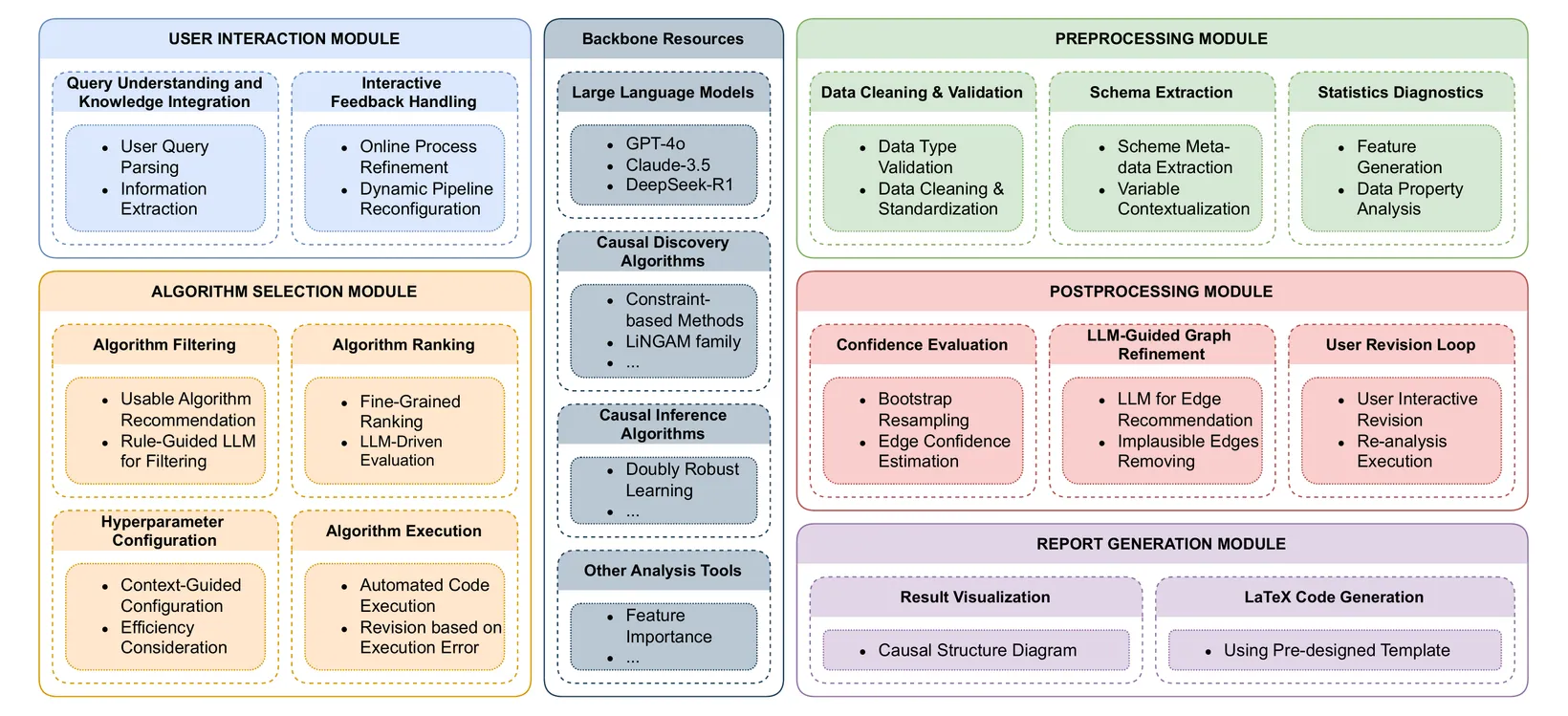
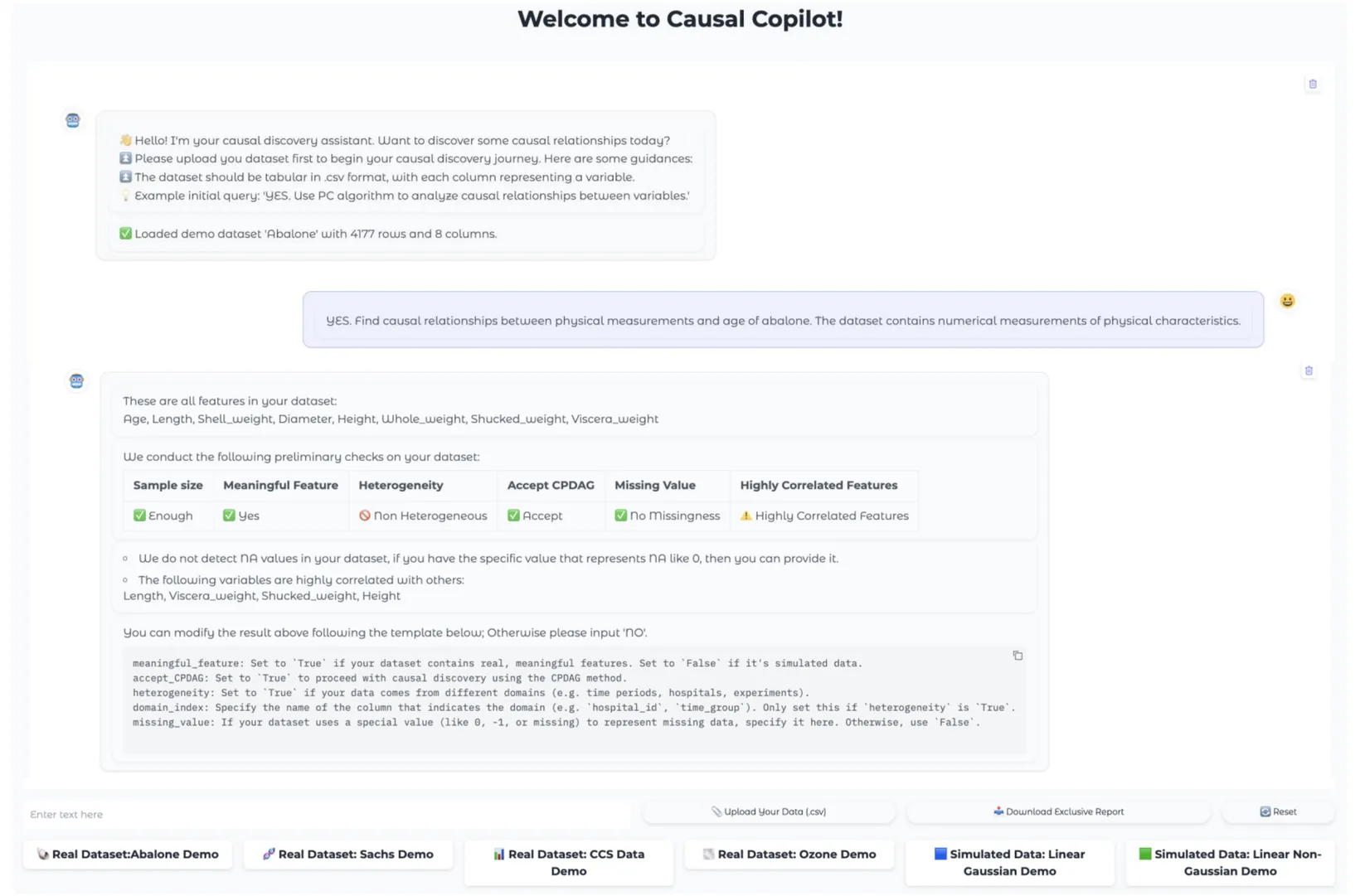
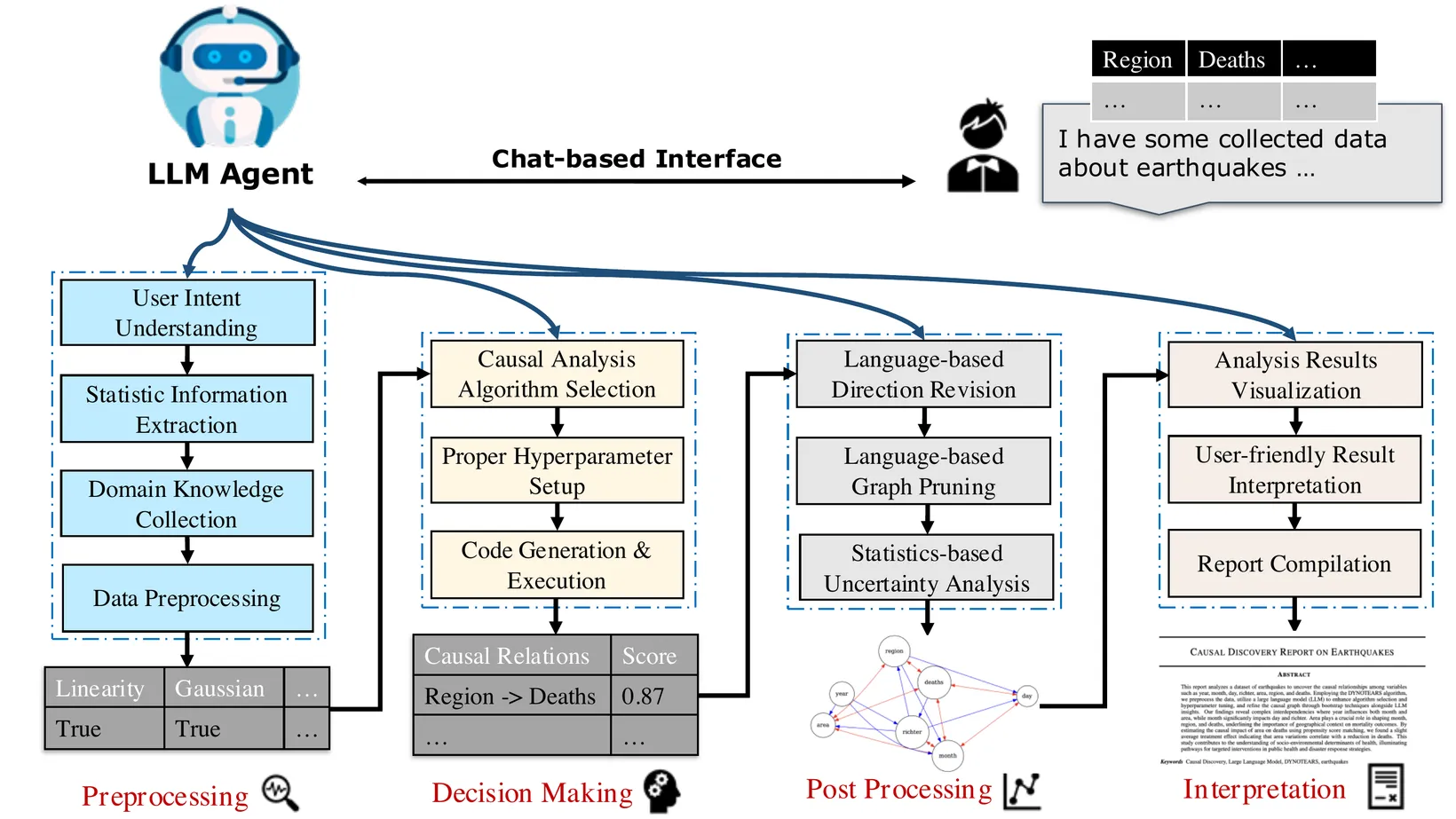
Users upload their data and describe their goals in natural language; Causal-Copilot handles the rest. The system is built on five modules.
User interaction. Query parsing, domain knowledge integration, interactive feedback loop.
Preprocessing. Cleaning, schema extraction, diagnostics — linearity, stationarity, heterogeneity.
Algorithm selection. LLM-guided filtering, ranking on data characteristics, hyperparameter configuration.
Postprocessing. Bootstrap confidence, LLM-guided graph refinement, user revision loop.
Report generation. Graph visualization, result interpretation, LaTeX report compilation.
Coverage
Causal-Copilot integrates 20+ state-of-the-art algorithms across discovery, inference and auxiliary analysis: constraint-based (PC, FCI, CD-NOD, PCMCI), score-based (GES, FGES, XGES, GRaSP), continuous optimization (NOTEARS, GOLEM, CALM, CORL, DYNOTEARS), the LiNGAM family, MB-based methods and Granger causality; double machine learning, doubly robust learning, instrumental variables, matching and counterfactual estimation; plus SHAP-based feature importance and causal root-cause analysis.
Performance
Causal-Copilot consistently outperforms individual algorithms as scenarios get harder — the gap widens exactly where hand-picked methods break down.
| Scenario (F1) | Copilot | Best baseline |
|---|---|---|
| Dense graph | 0.65 | 0.44 |
| Large scale (p=50) | 0.94 | 0.79 |
| Non-Gaussian noise | 0.97 | 0.86 |
| Heterogeneous domains | 0.77 | 0.62 |
| Time series, large lag | 0.85 | 0.84 |
Run it
python main.py --data_file data.csv --apikey YOUR_KEY \
  --initial_query "Discover causal relationships"

python Gradio/demo.py